
If you’re new to wrestling, there’s a point where the fans start sounding like they’re speaking another language. Somebody got buried. Somebody else has heat. A guy did the job, another guy went over, and now everyone is arguing about whether a promo was a shoot, a work or a worked shoot.
Yeah, wrestling has its own vocabulary. A lot of these terms came from wrestlers and promoters talking behind the scenes long before fans had podcasts, social media and wrestling news sites feeding them every detail. Now the insider language is everywhere, so here’s what the hell everyone is actually talking about.
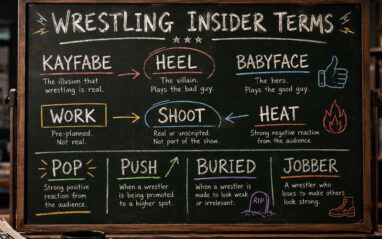
Kayfabe, work and shoot — Kayfabe means treating wrestling like it’s real. Back in the day, wrestlers went to ridiculous lengths to protect it, including heels and babyfaces avoiding each other in public. A work is something planned for the show. A shoot is something real. Fake injury? Work. Legit injury? Shoot. Two wrestlers pretending to hate each other? Work. Two wrestlers actually throwing punches backstage? Definitely a shoot.
Then you have the worked shoot, which is wrestling deliberately screwing with your head. That’s when something is planned but uses enough real-life drama to make fans wonder whether somebody just went off-script. Contract issues, backstage beef and personal problems can all get thrown into the mix. If everyone online is arguing, “Was that real?” the segment probably did its job.
Babyface, heel and tweener — This part is easy. The babyface is the good guy. The heel is the bad guy. A tweener hangs somewhere in the middle and can act like an asshole while fans still cheer them. When somebody switches sides, that’s a turn. Good guy becomes bad? Heel turn. Bad guy suddenly saves the day? Babyface turn.
Over, getting over, heat and pops — If a wrestler is over, the crowd gives a damn about them. Huge cheers work. Huge boos work too. Silence is the problem. Getting over is simply the process of reaching that point.
Heat usually means boos, but context matters. A heel getting booed out of the building has heat with the crowd. A wrestler with backstage heat has pissed off people they actually work with. Those are two very different nights at the office.
A pop is a big positive reaction. A cheap pop is when somebody takes the easy route by screaming the city’s name or praising the local team. Cheap heat is the opposite. Walk into Philadelphia, trash the Eagles and watch how quickly 15,000 people decide they hate you.
Push, rocket push and burial — A push means the company is moving somebody up. More wins, more TV time, bigger opponents and maybe a title shot. A rocket push means they hit the gas and skip half the process.
Then there’s “buried,” a word wrestling fans love using every time their favorite loses a match. One loss isn’t a burial. Calm down. A real burial is when someone gets beaten repeatedly, made to look useless and stripped of their credibility in the process.
Protected, put over and go over — Sometimes somebody loses but the company still wants them looking strong. That’s being protected. Maybe somebody interferes. Maybe the winner cheats. Maybe it takes three finishers and half the roster to finally beat them.
Putting someone over means helping them look important. Losing to them is the obvious way, but a huge star can also put someone over just by treating them like a legitimate threat. Going over is much simpler. It just means winning.
The rub — If a younger wrestler gets paired with a huge star, they can get what wrestlers call “the rub.” Basically, some of that star power is supposed to transfer. If the biggest name in the company suddenly treats you like you belong in the main event, fans might start seeing you differently too.
Job, jobber and squash — Doing the job means losing the match. A jobber is someone whose main role is losing so other wrestlers can look good. “Enhancement talent” is the nicer corporate version. A squash is when they barely even pretend it’s competitive. One wrestler comes out, destroys the other person and goes home. If you had time to microwave lunch during the match, you probably just watched a squash.
Spot and spotfest — A spot is a planned moment in a match. It could be a reversal, a dive or somebody launching themselves off a ladder through furniture for reasons that seemed perfectly reasonable when they discussed it backstage. A spotfest is basically one huge move after another. Some fans love it. Others start screaming about psychology five minutes in.
Selling and no-selling — Selling means acting like the moves actually hurt. Your knee gets wrecked? Limp. You get powerbombed through a table? Maybe don’t immediately sprint around like you just drank three Red Bulls.
No-selling is when someone takes offense and barely reacts. Sometimes it’s intentional because they’re supposed to look like a monster. Other times it just makes the guy hitting them look like an idiot.
Bump and botch — A bump is the fall a wrestler takes when getting slammed, thrown or knocked down. A botch is when something gets screwed up. Missed move, bad timing, slipped rope — that’s a botch. The best wrestlers can botch something and recover so smoothly that half the crowd never realizes anything went wrong.
Potato and receipt — Now we’re getting into the fun stuff. A potato is when somebody legitimately hits their opponent harder than they were supposed to. Maybe it was an accident. Maybe not.
A receipt is what can happen afterward. You hit me too hard? Fine. Here’s one back so you understand the message. Wrestling has its own customer service department.
Stiff — Working stiff means the contact is harder and looks more realistic. That doesn’t necessarily mean the wrestlers hate each other. Some people simply work a style where the punches, kicks and chops have a little more mustard on them.
Blading, color and hardway — Blading is when a wrestler intentionally cuts themselves to bleed during a match. The blade itself has traditionally been called a gig. Wrestlers also call blood “color.”
Hardway is when the blood wasn’t created with a blade. Somebody actually got split open. If you hear that someone “got color hardway,” something connected for real.
Gorilla Position — Gorilla is the area directly behind the entrance curtain where wrestlers wait before walking onto the stage. Producers, officials and other staff are usually stationed around there. The name comes from Gorilla Monsoon, and it’s still used all over wrestling today.
Go home and take it home — No, nobody is telling the wrestlers to pack their bags. If a referee or producer gives the “go home” instruction, it means get to the finish. Television time is running out, so wrap this thing up.
Calling it in the ring — Not every wrestling match is memorized move-for-move like a dance routine. Experienced wrestlers may call parts of the match while it’s happening, communicating with each other and changing things based on the crowd.
An audible is when the original plan changes on the fly. Somebody gets hurt, the show is running long or something unexpected happens and suddenly everyone has to adjust.
Producer, agent and road agent — These are the people helping wrestlers put matches together backstage. They go over the structure, major spots, timing and the finish. “Road agent” is the old-school term. Producer is what you’ll hear more often today.
The office, creative and booking — “The office” is wrestling slang for management. Creative is the group handling storylines and TV direction. Booking is the actual decision-making: who wins, who loses, who gets pushed, who turns heel and who gets stuck losing in three minutes. If an old wrestler says, “The office booked me to do the job,” you now know management told him he was losing.
Hotshotting — This is when a promotion burns through something big way faster than expected. Major match with almost no build. Surprise title change. Huge storyline twist thrown onto television because somebody wants an immediate jolt. Sometimes it creates a great moment. Sometimes fans are left wondering why the company just blew through three months of material in one night.
Swerve — A swerve is when wrestling deliberately makes you expect one thing and then gives you something completely different. The best ones make you say, “Holy shit.” The worst ones make you ask why you bothered paying attention in the first place.
Program and blowoff — A program is an extended feud between wrestlers. Promos, attacks, matches — the whole thing. The blowoff is supposed to be the final match where everything gets settled.
“Supposed to” is doing a lot of work there because wrestling feuds have a habit of coming back from the dead.
Dark match and house show — A dark match takes place at a TV taping but doesn’t air on the main broadcast. A house show is a non-televised live event. WWE usually calls them live events now, but “house show” is still the term you’ll hear from wrestlers and longtime fans.
Papering the house — A packed arena doesn’t always mean every seat was sold. Papering the house means giving away tickets or offering heavy discounts to make the building look fuller. It’s an old promotional trick and definitely not something wrestling invented.
Draw — This is the one promoters care about. A draw brings people in. Tickets, viewers, merchandise, pay-per-view buys — whatever makes money. Fans can argue about star ratings and workrate until everybody turns blue, but if one wrestler puts asses in seats, the company knows exactly what that means.
Ring psychology and ring general — Psychology is simply whether the match makes sense. If your leg gets destroyed for 15 minutes and you’re doing flips with no problem 30 seconds later, people are going to notice.
A ring general is somebody who knows how to control the match, work the crowd, manage the pace and keep everything together when things start going sideways.
Good hand — A good hand is a wrestler the company trusts. They might never be the world champion, but you can put them in the ring with almost anybody and expect them to get the job done. That’s a compliment in wrestling, even if it doesn’t sound like one.
The boys — Wrestlers have traditionally referred to the locker room as “the boys.” So if you hear an old-timer saying, “The boys hated that,” they’re talking about the other wrestlers backstage, not some mysterious gang following the company around.
Politicking and stroke — Politicking is exactly what it sounds like. Wrestlers trying to improve their position behind the scenes, avoid a loss, get a bigger push or convince management to change something.
Stroke means influence. If somebody has a ton of stroke backstage, their opinion carries weight. Wrestling history has plenty of stories about people with enough stroke to suddenly decide losing “doesn’t work for me.”
Going into business for yourself — This is one of the quickest ways to create a real problem backstage. It means ignoring what was agreed upon and doing something for your own benefit. That could mean changing a promo to embarrass somebody, refusing to cooperate in a match or deliberately making your opponent look bad. At that point, you’re not working the storyline anymore. You’re creating legitimate heat.
And that’s the language of wrestling in a nutshell. Once you know the difference between a work and a shoot, understand why getting heat can either be great or terrible, and realize “go home” doesn’t mean somebody missed their flight, wrestling suddenly becomes a hell of a lot easier to follow.
Before long, you’ll be complaining that somebody got buried after doing the job because they lost their push due to backstage heat with the office — and everyone around you will wonder what the hell happened to you.
What wrestling term confused you the most when you first started watching? Please share your thoughts and feedback in the comment section below.
