
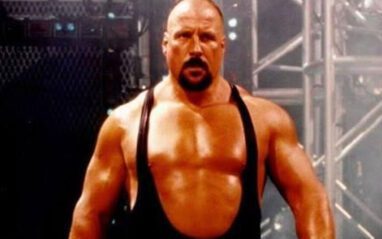
Scott Norton looked like a guy WCW should have been able to turn into an absolute monster, but Eric Bischoff says there was a major reason Norton never reached the same level in America that he did in Japan.
During a recent episode of 83 Weeks, Bischoff and Conrad Thompson looked back at the September 9, 1996 episode of WCW Nitro. The conversation eventually landed on Norton’s submission match against Sgt. Craig Pittman, which lasted roughly three minutes and was used to set up Norton’s upcoming match with Ice Train at Fall Brawl.
That led Thompson to question why Norton never moved further up the WCW card. Norton became a major name in Japan and eventually found a home in the nWo alongside Buff Bagwell as Vicious and Delicious, but he was never positioned as one of WCW’s true top singles stars.
Bischoff explained that Norton’s style was almost perfectly built for Japan. His ridiculous strength, durability and ability to work the Japanese strong style allowed him to connect with that audience in a way few American wrestlers could. The problem was that bringing that exact same Scott Norton into WCW created an entirely different set of problems.
“Well, Scott was hugely successful in Japan because Scott not only understood the Japanese style, but he was so powerful and durable that he could go out there and connect with the Japanese audience from a psychology point of view in ways that very few Americans could consistently. But it was definitely that strong style, if you will. Didn’t sell much, right? Not a lot of depth in terms of offense. So visually, you know, impressive because of the power, but not visually engaging, if you will. Like a belly-to-back suplex, for example, which is very visual, right? But that was his strength in Japan.”
The bigger issue was finding believable opponents for Norton in WCW. Bischoff said keeping Norton as the same wrecking machine fans saw in Japan would have required putting him against wrestlers he could simply destroy, and WCW didn’t have enough guys who could realistically stand across from him without damaging that presentation.
“Now Scott couldn’t bring that same character over to the United States because who would he work with? I mean, you can’t just have him come in and squashing, you know—we didn’t have a lot of guys on the roster that were believable, you know, in a way that you could set up with Scott Norton that he just wouldn’t eat alive in order to keep his character alive.”
That forced Norton to change. Instead of simply being the terrifying powerhouse who could walk through people, Bischoff said Norton had to fit into an American wrestling product that placed much more emphasis on characters and storylines.
“So it required that Scott had to adapt to a more American version of the property, which was more storyline driven and more character driven. Certainly you saw that with Vicious and Delicious. That was absolutely all character driven. I don’t think you could have gotten more opposite of the Japanese strong style that Scott became famous for over in Japan. I don’t think he could have come up with something a whole lot different than what he did here with Marcus Bagwell.”
Bischoff believes the nWo ultimately gave Norton a way to make that transition because he no longer had to carry everything on his own.
“And I think the nWo was, you know, a transition in there to that in the sense that, you know, Scott was part of a team. He was part of something bigger and he wasn’t just out there, you know, crushing people.”
Norton absolutely had the size, strength and credibility to look like one of the baddest men on WCW television, but Bischoff’s explanation makes it clear the problem wasn’t simply whether WCW believed in him. The version of Norton that became such a force in Japan was difficult to recreate in an American wrestling environment, and once WCW started changing that formula, he became part of the nWo machine instead of the unstoppable singles monster he had been elsewhere.
Do you think WCW could have done more with Scott Norton as a top singles star, or was Bischoff right that his Japanese presentation simply didn’t translate the same way in America? Let us know what you think in the comments.
This transcript was produced exclusively for Ringside News from the original recording. Republishing the transcription in full is prohibited. When using excerpts, provide prominent credit and a link to this article.
