
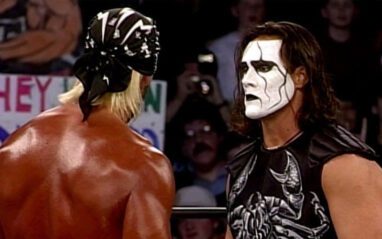
Hulk Hogan vs. Sting at Starrcade 1997 was supposed to be one of the cleanest payoffs in WCW history. Instead, the finish turned into a complete mess just hours before the bell rang.
During a conversation with Inside the Ropes, Eric Bischoff explained that the plan was never supposed to be complicated. Sting was going to beat Hogan clean, end the nWo’s grip on WCW and finally give fans the payoff they had waited more than a year to see.
“The original plan was Sting was going to put an end to Hulk Hogan. WCW was going to get their company back. The nWo was going to be on their heels—as heels, so to speak. They were going to be backing up, WCW was on top, and now it was time for the nWo to figure out a way to rise again.”
There was no fast count in the original plan. There was no Bret Hart restart. Sting was supposed to pin Hogan in the middle of the ring and walk out as WCW’s hero.
“When we got to Washington, D.C.—when I landed in Washington, when Hulk landed and when Sting landed—the plan was for Sting to beat Hulk Hogan clean. No fast count. Just one, two, three in the middle of the ring.”
“After all this time, Sting was going to be the superhero once again. He was going to shed that Crow character and become the babyface he had previously been.”
That plan began falling apart on the afternoon of the show. Bischoff said Steve Borden had been dealing with serious personal issues during the Sting storyline. Once everyone met before Starrcade, concerns came up about where Borden’s head was at and whether he was ready to carry the match the way WCW needed.
“There was a period in time, ’96 and ’97, where Steve Borden was going through some intense personal issues.”
“When we all got together that afternoon, there was doubt. There was concern about where Steve Borden’s head was at, and then it kind of cascaded from there.”
Bischoff still believes Sting would have delivered once the match started. The problem was that the confidence around the original finish had already been shaken.
“Truth is, it would have worked. Sting would have come through. It would have been just fine. But chemistry matters, folks. Chemistry really matters. When the chemistry isn’t right and there’s insecurity or a lack of confidence, things can go south pretty quickly, as they did that night.”
Hogan then dug in against losing clean. Bischoff said he tried to act as the middleman and find a solution, but Hogan was not budging. Once the clean pin was dead, WCW had only a few hours to build a new finish for the biggest match of the year.
“I was like the referee. I was trying to guide the conversation. I was trying to find solutions. I knew Hulk pretty well by that point, and most of the time I was able to do a pretty good job of managing where his head was at. But he was dug in pretty stiff.”
“We had a really great story. It was black and white. It was a good guy and a bad guy. It was a resolution. It was an arc that took over a year—almost a year and a half—to play itself out. It was set up perfectly until about three o’clock that afternoon, and then it all went to shit.”
The issue came up around two or three in the afternoon. Starrcade started at eight, which left WCW roughly five or six hours to replace the finish that had been planned for months. Kevin Sullivan and several others became involved. The more people who entered the conversation, the messier the ending became.
“Once it became clear that we weren’t going to go with Plan A, Kevin Sullivan got involved, different people got involved, and it ended up being more of a collaboration among four, five or six people until everybody finally ended up with the cluster that we saw.”
Bischoff said the story still demanded that Sting win clean, but that option was no longer available. WCW settled on a muddy finish involving referee Nick Patrick, an intended fast count and Bret Hart stepping in to restart the match.
“For the story, Sting should have won clean. That was what was important to me, but that wasn’t going to happen. It had to be a muddy finish.”
Then the replacement plan fell apart inside the ring. The count did not look fast enough to justify Bret Hart stopping the match. Sting also failed to raise his shoulder during Hogan’s pin, making the three-count appear normal. That left Bret looking like he had interfered in a finish that did not need to be overturned.
“Because nobody was communicating. You had four or five people involved, and not everybody agreed 100% with the finish and the way they wanted to do it.”
“If you go back and look at the tape—look at the tape very closely—there was supposed to be a fast count. Sting never got his shoulders up. It fell apart so badly and so fast because of a lack of communication.”
Bischoff said the finish became too complicated for the audience to follow. What began as a simple clean victory turned into a committee-built ending where everyone had a piece of the plan, but nobody was fully on the same page.
“There’s a saying: a camel is a horse created by committee. That’s what that finish was. It was a camel. It started out as a horse and was created by a committee of people who weren’t doing a very good job communicating.”
Bischoff also put part of the blame on Sting. He said Borden was supposed to lift his shoulder during the pin, which would have helped sell the fast-count controversy and made Bret Hart’s involvement make more sense.
“Honestly, Steve Borden bears some responsibility because he missed a kick-out when he should have. He should have rolled a shoulder when he was supposed to, and he didn’t. That’s one of the things that made Bret look so bad.”
WCW had spent more than a year building Sting as the man who would finally destroy Hogan and save the company from the nWo. By the afternoon of Starrcade, the simple ending was gone. By the time the match ended, poor communication, creative control and a last-minute compromise had turned WCW’s biggest payoff into one of its most infamous finishes.
Do you think WCW should have forced the original clean victory, or was the Starrcade 1997 match already doomed before Hogan and Sting entered the ring? Let us know what you think and leave your feedback in the comments.
This transcript was produced exclusively for Ringside News from the original recording. Republishing the transcription in full is prohibited. When using excerpts, provide prominent credit and a link to this article.
