
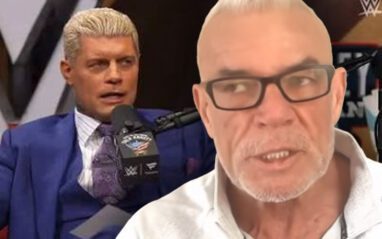
Eric Bischoff believes WWE is making a mistake by turning Cody Rhodes into a podcast host while he is still positioned as one of the company’s biggest stars. Bischoff has plenty of respect for Rhodes and believes he is good in the role, but that is exactly why he thinks WWE needs to be more careful about overexposing him.
The subject came up during the 83 Weeks podcast while Bischoff and Conrad Thompson discussed WWE’s habit of pulling back the curtain on its wrestlers. Thompson argued that Rhodes should be treated as the special guest people want to hear from, not the person regularly sitting down to interview everyone else.
Thompson pointed out that Steve Austin hosted a podcast after his full-time wrestling career had ended, not while he was WWE Champion and working WrestleMania main events. He argued that Rhodes interviewing someone such as Santino Marella reverses the roles because Cody should be the special attraction.
“I think the whole Cody Rhodes podcast is a mistake. In my opinion, he’s having guests on and interviewing them like they’re the interesting person, but we’re also positioning him to be the top guy.”
“There was a Stone Cold Steve Austin podcast, but he didn’t do it while he was wrestling at WrestleMania. He didn’t do it while he was the champion. He did it once he was retired.”
“Cody Rhodes interviewing Santino Marella—that should be the other way around. Santino needs a podcast, and then every now and again we’re graced with the presence of Cody Rhodes.”
“When you just have him do a regular podcast and he’s having conversations with guys, it makes him less special because he’s here. We’re familiar. We’re comfortable. He is good at it. He is relatable. He is likable. But are we overexposing him? He should be the special attraction. He’s not the guy who does the interviewing. He’s the guy who is interviewed.”
Bischoff completely agreed with Thompson’s argument. He made it clear that his criticism was not aimed at Rhodes’ ability as a host, but at WWE placing an active top star in a role that removes some of his shine.
“You’re absolutely right. I would not have said it had you not brought it up, but I can’t stand seeing Cody Rhodes in that role for the very reason you just described.”
“Is he good at it? Yeah. I really have nothing but respect and affection for Cody. I like Cody, and I hate to see him doing something that I think dulls the luster of who he is and what he’s achieved.”
“He should be on the other end of that interview and made a star. Vince was constantly cognizant about making stars, and this is the opposite of making a star.”
Bischoff connected the podcast to WWE’s broader willingness to show fans how the machine works. Between podcasts, behind-the-scenes footage and WWE: Unreal, he believes WWE is transforming its Superstars into regular people when the entire point should be making them feel bigger than everyone else.
“This broader approach of overexposure and peeling back the curtain even more than it already has—you could probably point to WWE: Unreal—all of these things, in aggregate, are just making these Superstars people.”
“We don’t pay money to go see people. We pay money to go see stars. We’re not making them stars. We’re making them versatile. We’re probably getting a return on the investment, but we’re not really building a star, are we?”
Thompson noted that Rhodes was already a star before he sat down behind the microphone, meaning the podcast cannot elevate him any further. In his view, constant access only creates the possibility of Cody fatigue among fans who already see Rhodes across WWE television, live events, advertisements and promotional appearances. Bischoff closed the point by explaining that too much exposure can kill a wrestling character just as easily as disappearing from television.
“There are two ways of killing off a talent: not giving them an opportunity and letting the audience forget about them because they haven’t been on TV in six months—AEW—or overexposing them.”
“They both have the same outcome. Underexposure and overexposure equal a dead character. Vince was a master at knowing when to say when.”
Rhodes may be skilled enough to handle wrestling, media appearances, sponsorships and podcast interviews, but Bischoff believes being capable of doing everything does not mean WWE should ask him to do everything. In his eyes, every extra appearance risks making one of WWE’s top attractions feel a little less special.
Do you agree that hosting a podcast overexposes Cody Rhodes, or does the show help fans connect with him on a different level? Let us know your thoughts in the comments.
