
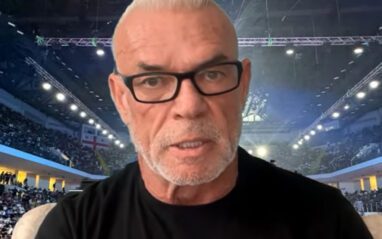
Eric Bischoff believes AEW’s announcers failed viewers during AEW All In 2026. While he praised the spectacle at Wembley Stadium, Bischoff said the commentary team didn’t do enough to explain the stories or stakes behind several matches.
The subject came up on 83 Weeks after Bischoff discussed Kazuchika Okada, Kyle Fletcher and Konosuke Takeshita’s match. He enjoyed the action but had no idea why the three men were fighting because the announcers never gave him the necessary background.
“A lot of great high spots. I don’t know what the backstory was. Certainly, the announcers didn’t help me out much. They called the action, but there was no backstory. There was no narrative that helped me understand why I’m watching this.”
Bischoff made it clear that he wasn’t a regular AEW viewer going into All In. However, he argued that this is exactly why the commentary team needed to explain the stories. A major pay-per-view will attract people who don’t watch Dynamite or Collision every week, and those viewers shouldn’t be expected to figure everything out on their own.
“I think that’s a good note for the announcers as well—your narrative. Your announcers get more camera time than anybody. They’re out there for three hours. Their job is to educate people like me, to engage people like me who may not be familiar with all of the backstory.”
Bischoff said the job should begin before the matches and continue throughout the show. In his view, the pregame and commentary should make sure casual viewers understand why each match matters.
“That’s what a pay-per-view is for. That’s what the pregame is for—to set up that backstory and help people who are just dropping in to the pay-per-view, because there are a lot of them, by the way. Obviously, AEW does pretty well on their pay-per-views, so there are a lot of people who are going to tune in to the pay-per-view who may not be watching, who may not be one of the five, six or seven hundred thousand people who watch the show during the week.”
Bischoff then pointed to Jon Moxley and Nigel McGuinness as another example. Conrad Thompson explained that McGuinness entered the match injured after fighting through a tournament, but Bischoff said the broadcast didn’t properly walk him through that story.
“It’s important that the narrative flows through all the way up until and including the last match on the pay-per-view. I didn’t get a lot of help from the announcers in that regard. That would be a note, as a producer, that I would talk to my announcers about: Keep that narrative. Keep the audience reminded as to what the stakes really are.”
“In the case of Nigel and Moxley, don’t be afraid to go back and tell me from the beginning how this thing started and why we’re here tonight. All of those are tools that you can use to engage people like me, whether I have been watching the show or not—to engage me more in what’s going on, to make me pay more attention to what the stakes are or to care more about the stakes.”
Bischoff felt the announcers focused too much on describing the moves happening in front of them. They made observations during the matches, but he never received the complete story he needed to become invested.
“I didn’t get any of that. I got a lot of calling the action. They made some interesting comments, but nobody really told me much of a story.”
Bischoff’s point was simple: AEW All In is the company’s biggest show and attracts more than its weekly audience. If the announcers don’t explain why the matches matter, viewers dropping in for the event are left watching moves without understanding the fight behind them.
Do you agree that AEW’s announcers failed to explain the stories at All In, or should viewers already know the full build before ordering a pay-per-view? Let us know what you think in the comments.
This transcript was produced exclusively for Ringside News from the original recording. Republishing the transcription in full is prohibited. When using excerpts, provide prominent credit and a link to this article.
