
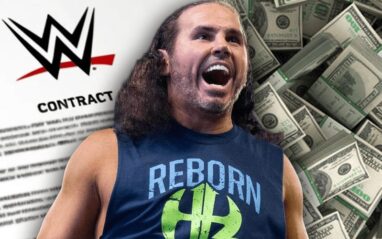
Matt Hardy is pulling back the curtain on exactly how much money he was making during the early days of his WWE career — and the numbers are a serious blast from the past.
Speaking on the latest episode of The Extreme Life of Matt Hardy, Hardy broke down the exact pay structure from both his first WWE developmental contract and his first full-time roster deal alongside his brother Jeff Hardy.
Before signing any official WWE deal, Hardy explained that he and Jeff were originally working as enhancement talent during WWE television tapings back in 1994 for just $150 per night.
“Even getting our foot in the door at WWE, as extra work, as enhancement talent, we would make $150 a night. That was the original deal.”
Hardy said those early appearances included tapings for RAW, Superstars, and Wrestling Challenge while WWE stacked weeks of television content at once. Years later, WWE finally offered the Hardy Boyz their first real developmental contracts through Jim Ross and Bruce Prichard in early 1998. That deal paid far less than many fans today probably imagine.
“Our developmental deal would be, this was our initial developmental deal, our first contract, it was $300 a week, and then we would make $300 per appearance.”
Hardy explained the deal also included rental cars and hotel coverage while they were still considered developmental talent.
“When we were a developmental act, we had our rental cars paid for… And our hotels were also paid for at that time on the developmental deal.”
Things changed dramatically after the Hardy Boyz caught fire during WWE house shows against Edge and Christian Cage. Hardy said WWE quickly decided to officially repackage them as a full-time act with Michael Hayes attached as their manager.
That led to the brothers signing their first major WWE roster contracts in early 1999. Hardy then revealed the full year-by-year breakdown of the deal. He also explained how WWE downside guarantees worked at the time.
“We signed a regular deal, which was five years. It was a five-year deal, $75,000, $75,000, year $200,000, year three, $125, year four, $150, year five.”
“We’re guaranteed to make 75. If one of our bookings didn’t equal up to 75, if we made 69,000 at the end of the year, then they owed us $6,000 more.”
Hardy noted that once they graduated from developmental contracts, WWE stopped covering all travel expenses. Even their rental car perk eventually disappeared despite WWE’s booming business during the Attitude Era.
“Once we signed a regular contract, our contract was smaller. They picked up our hotels at TV. But then when we were on the road doing house shows, we had to pay for our own hotels.”
“They were making so much money, they took it. They took it away from us.”
Looking back, Hardy said one of the best parts about WWE contracts during that era was the downside guarantee system because it gave wrestlers at least some financial security while still allowing top stars to earn significantly more through success on the road.
“When there were actual downside guarantees, where you had a safety net, like you won’t, you’re promised you won’t fall below this, was great.”
The money may sound small compared to today’s wrestling contracts, but those deals helped launch the Hardy Boyz into becoming one of WWE’s most successful tag teams of all time.
Do WWE developmental contracts from the late ‘90s surprise you compared to how much talent earns today? Please share your thoughts and feedback in the comment section below.
