
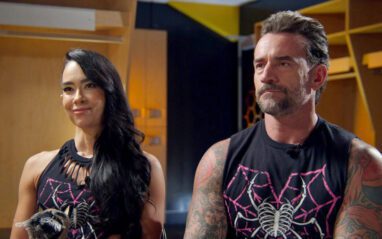
WWE Unreal showed fans a personal side of CM Punk and AJ Lee that rarely makes it onto weekly television. Punk spoke about his marriage with real emotion, AJ opened up in a way viewers don’t normally see, and even their dog Larry helped make the couple feel like actual people instead of scripted wrestling characters.
During the Coach and Bro Show, Vince Russo argued that WWE should be using those real personalities and experiences to build storylines that give fans a reason to care. Russo said WWE Unreal made him feel more connected to Punk and AJ than anything he had seen from them on WWE programming.
“I’m hearing AJ Lee talk. I’m hearing Punk talk about the marriage, and you can see his love for his wife. I’m caring about this dog that looks like the Wolf Man. I’m watching this, and I’m like, ‘I am caring about these people. I literally am caring. I like AJ Lee now. I didn’t know.’”
Punk’s reaction while discussing his wife made him come across as a real person instead of another wrestler cutting a promo. Russo said that version of Punk was easy to like. The problem, according to Russo, is that those personalities vanish once Punk and AJ step back inside WWE’s wrestling bubble.
“When I’m hearing Punk talk, and you look at his face when you see him glowing about his wife, a man like me, I like that guy. I like that guy. Now I’m seeing two very likable people and a likable dog.”
“I watch the product when they’re in the wrestling bubble, whatever you want to call it. I’ve got no emotional feeling for Punk. I’ve got no emotional feeling for AJ Lee. I don’t care about these people on the wrestling show. Why aren’t these people on the wrestling show an extension of the people I’m seeing on Unreal?”
Russo said WWE has turned too many performers into interchangeable wrestling characters. They speak the same way, react the same way and rarely give fans anything personal to grab onto.
“This is what you’re freaking missing, man. These are real people. What we’ve created here now is everybody is a wrestler. They think the same, they feel the same, and they talk the same.”
Liv Morgan was another example Russo used. Morgan has spoken about growing up in difficult circumstances before reaching WWE, but that journey is rarely used to add anything to her television character. Russo believes that kind of story could immediately change how fans see her.
“I know Liv Morgan grew up in a freaking trailer park. If I knew how rough Liv Morgan’s life was growing up, you don’t think I would care about her and watch her as a performer more than I do? You’d never hear about that story on the show.”
Russo also brought up a recent conversation with an unnamed JCW wrestler who told him they were beaten every day during childhood. His first thought was not to hide that experience, but to ask whether the performer would be comfortable using it to show fans what they had survived.
“My first knee-jerk reaction is, ‘Can we talk about that? Can we tell that story?’ Because now, if I’m watching the show and I know that’s what you went through as a child, and you were able to overcome all that, and here you are, you’re going to be over huge. If it’s okay with you, can we use that?”
Russo made it clear that these stories should only be used with the wrestler’s permission. His point was that real struggles can create an emotional connection that another scripted argument or surprise attack cannot match.
AJ Lee’s past discussions about mental health were another missed opportunity in Russo’s eyes. She has publicly shared that part of her life, but WWE has not made it a meaningful piece of her current character.
“AJ Lee has spoken about mental health. She’s written books about it. She’s talked about this. If I know that side of it and I know her struggles, now I am pulling more for her. But to totally ignore the story, I don’t understand.”
Bron Breakker’s appearance on WWE Unreal offered another example. Fans saw him fishing, speaking about Rick and Scott Steiner and showing how much his family means to him. Russo questioned why that version of Breakker is missing from WWE television.
“You see the love of his uncle and his dad. You see how well-spoken and educated the dude is. Why are we not showing these people now, bro?”
Wrestlers still need characters, rivalries and reasons to fight. Russo’s argument is that those characters should start with the actual person instead of burying everything real underneath another generic gimmick.
“Wrestling is a work, so they have to have a character, but they’ve got to be an extension of who they are.”
WWE already has the stories it needs sitting inside its own locker room. The challenge is turning those real personalities, relationships and struggles into television that makes fans care before the bell even rings.
This transcript was produced exclusively for Ringside News from the original recording. Republishing the transcription in full is prohibited. When using excerpts, provide prominent credit and a link to this article.
Should WWE use more of its wrestlers’ real-life stories in television angles? Please share your thoughts and feedback in the comment section below.
