
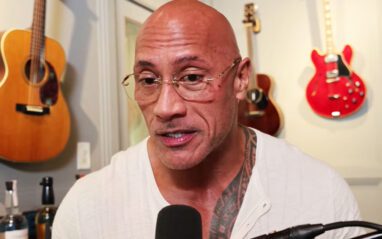
The Rock may be one of Hollywood’s biggest stars today, but it turns out his wrestling career gave him a pretty big advantage when he first started acting. In fact, he recently recalled an early acting lesson where he was given just 60 seconds to prepare a lengthy monologue, and his years of cutting promos in WWE helped him get through it.
Speaking with Elmo Lovano, The Rock was discussing Morgan Freeman’s belief that acting isn’t something a person can completely learn in a classroom. While training certainly helps, Freeman believes a performer needs to have something naturally inside them, and Rock admitted he didn’t fully understand that idea when he first entered Hollywood.
“I didn’t understand what Morgan was saying when I first started because when I first started, it was really baptism by fire for me because I started—I got into acting at 29, and that was when I had a full-fledged wrestling career and I was making the transition.”
At the time, Rock wasn’t interested in simply making a movie or two before returning to wrestling full-time. He wanted a legitimate acting career, so he started working with professional coaches to improve his skills, something he says he continues doing today.
“And when we made the transition, I was, okay, I want to have a career at this. I want longevity, and I need to learn as much as I possibly can. And so I worked with great acting coaches, who I still work with today.”
Rock then recalled something that happened during only his second or third acting lesson. His coach brought him onto a stage, turned off all the lights except for one spotlight, and handed him a lengthy monologue with almost no time to prepare.
“And I remember it was about our second or third acting session, and I was on a stage. Shut all the lights off and turned one spotlight on. And he said, ‘Here’s a monologue that I wrote. Look at it. You can memorize it if you want. Do what you want with it, but I want to hear it back in 60 seconds.’”
For most beginners, that probably would’ve been a pretty intimidating assignment. But Rock had already spent years standing in front of thousands of wrestling fans, delivering long promos and remembering what he needed to say without the luxury of multiple takes.
“And I looked at it, and it was pretty long. And I was used to memorizing monologues in wrestling because I would have these long monologues in wrestling.”
It wasn’t just about remembering lines, either. Rock explained that wrestling had taught him how to read a live audience, adjust his delivery and react to whatever was happening in the moment, which turned out to be just as useful when he started acting.
“And in a live crowd, as you know, many who are watching right now—as a musician, or even just in any kind of theater, live crowd—there’s a live crowd acumen that you are just intrinsically forced to have because, like you were saying in the beginning, you got to listen, and the crowd will always dictate where you go and where you need—what you need to do.”
When Rock finally performed the monologue, he admitted he probably didn’t get every word right. Instead, he focused on delivering the emotion and meaning behind the material, and apparently that was more than enough to impress his coach.
“So, I remember delivering this monologue that just came from here. Maybe I got a word or two right, but I got the essence of it. And after that—after that, he said, ‘We’re done.’”
Rock initially wasn’t sure what to make of that reaction, but his coach quickly explained what he meant. Rather than telling him he needed years of additional training before he could become an actor, the coach suggested Rock already had the instincts required to succeed.
“And he said, ‘You will decide what kind of actor you want to be, whether you want to stay in one lane or if you want to do all genres.’ And he goes, ‘But you’re there.’”
Of course, Rock didn’t immediately understand what his coach was trying to tell him. At that point, he was still learning the business and simply took the feedback as a sign that he might have some potential.
“And it was really—and I really didn’t know what ‘you’re there’ meant. I was like, ‘Oh, okay. He says I’m pretty good. Okay, must be all right.’ Or I got something.”
Looking back now, Rock says he finally understands what both his coach and Morgan Freeman were getting at. Acting classes can teach technique, but he believes there’s also an instinctive part of performing that can’t necessarily be taught.
“But I understand that now. And I understand what Morgan is saying because there’s so much—you can go to school, you can go to these workshops, and they’re all helpful and valuable, but at the end of the day, it just comes from in here. In your gut, behind the rib cage, you know.”
The Rock may have been new to Hollywood, but he already had years of experience performing under pressure. His early acting lessons showed him just how much wrestling had prepared him for the next chapter of his career, even if he didn’t realize it at the time.
Do you think The Rock’s wrestling career played the biggest role in making him a successful Hollywood actor? Let us know in the comments below.
This transcript was produced exclusively for Ringside News from the original recording. Republishing the transcription in full is prohibited. When using excerpts, provide prominent credit and a link to this article.
