
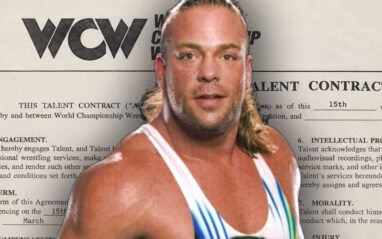
Rob Van Dam was technically working for WCW in 1993, but apparently there was one pretty major problem — he never actually signed the contract they kept asking him to turn in. RVD says he repeatedly told WCW officials the paperwork was signed and sitting at home, when the truth was he never put his name on it at all.
During an appearance on One of a Kind with RVD, Van Dam looked back on his brief WCW run and explained how quickly things changed after he started working in Japan. RVD had just taken his first loss in WCW before heading to All Japan Pro Wrestling, where he began building a relationship with Giant Baba that ultimately gave him another path outside the company.
“Did my first L and then went over to All Japan and got a lifetime relationship with Giant Baba over there. That would conflict with staying in WCW long term.”
RVD confirmed that he left WCW in May 1993 after being there for only around six months. Then he casually dropped the part of the story that makes the whole situation even crazier — he still has the contract WCW wanted him to sign.
“In May of ’93. So I was only there like six months, right? Wow. Yep. And I still got to — and I still got to dig out my contract to show you.”
According to Van Dam, Mike Graham kept checking in with him about whether the paperwork had been signed. RVD’s answer was basically the same every time: yes, it’s signed, I just forgot to bring it.
“Like I never turned it in. They kept — Mike Graham would say, ‘Uh, hey, did you get a chance to sign that contract?’ And I’d say, ‘Oh, you know what? I signed it, but I left it at home. I forgot to bring it.’ And he’d say, ‘Oh, well, can you bring it next week?’ I’d say, ‘Sure.’ And then I just never brought it.”
Except there was nothing sitting at home waiting to be delivered. Van Dam admitted he never signed the contract at all, and by May he had already decided there was no point pretending he wanted to stay.
“I never signed it, and I still have it. Yeah. And then eventually, like in May, I was like, you know what? I don’t want to stick around any longer. And he was like, why? I think I’m head out. Why not? Yeah. You know what? I’m done. I was like, I’m not really feeling it here.”
RVD was still only a few years into his wrestling career, but he said Sabu and The Sheik had already taught him that protecting yourself in the business meant more than just knowing how to take a bump. He had to protect his career, his value and the direction he was heading.
“And even though I was young and green, I was getting coached by Sabu and Chic, not just to take bumps, but to take care of myself and take care of my pathway in my career and to make the right decisions that aren’t going to bury me or be counterproductive.”
There was another problem waiting for RVD when he returned from his first All Japan tour. Bill Watts had been running WCW when Van Dam left, and RVD says Watts was the guy who hired him, liked him and was actively giving him opportunities. By the time RVD returned from Japan, Ole Anderson had taken over the booking — and suddenly Robbie V wasn’t getting the same treatment.
“When I left, it was Bill Watts that was in charge of WCW. It was Bill Watts that liked me, that gave me a job, that was giving me a push. And when I came back from a 15-day tour of All Japan, Ole Anderson now had the book, and he did not have the same interest in Robbie V. So I was either looking at the lights every night or I was in dark matches, sometimes giving tryouts to people and not being on TV.”
That was enough for RVD. He believed sticking around was only going to hurt his career, so he trusted his instincts and walked.
“So that’s why I was like, dude, my instincts and everything is telling me life would be better if I just [ __ ] leave right now. And so I did and didn’t regret it.”
Van Dam has spoken before about how controversial that decision looked to people around him. Ringside News previously covered RVD recalling Chris Benoit ripping into him for leaving WCW, with Benoit unable to understand why Van Dam would willingly walk away from a company that had him on television.
RVD clearly saw the situation differently. He wasn’t interested in hanging around just because WCW was a major company, and he definitely wasn’t rushing to sign a contract for a place where his momentum had already disappeared. More than three decades later, he says that unsigned deal is still somewhere in his possession — probably one of the strangest souvenirs from his entire career.
What do you make of Rob Van Dam never actually signing his WCW contract despite working there for months? Was walking away one of the smartest moves of his career? Let us know what you think in the comments.
This transcript was produced exclusively for Ringside News from the original recording. Republishing the transcription in full is prohibited. When using excerpts, provide prominent credit and a link to this article.
