
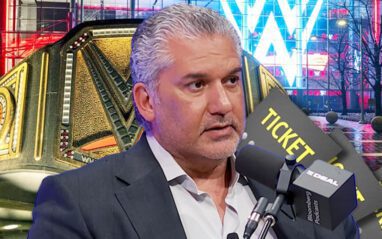
Nick Khan isn’t dancing around WWE’s ticket strategy. If you’ve got the money and want one of the best seats in the house, WWE apparently wants to find out exactly how much you’re willing to spend.
Speaking to Bloomberg, Khan was asked by Alex Rodriguez how WWE balances making money with keeping events affordable for regular fans. Rodriguez said it’s something he personally worries about while running the Minnesota Timberwolves and Lynx.
“Running the Minnesota Timberwolves and the Lynx, one of the things I spend a lot of time about is and lose sleep over is what do we do about raising prices, especially people that can’t afford it. When you’re running a public company now and part of a public company, how do you think about the needs of the fans versus the need of the business?”
Khan didn’t exactly give him the corporate answer you might expect. When it comes to WWE’s most expensive seats, he flat-out admitted the goal is to jack those prices up as high as possible.
“So how we look at a WWE is the P1 tickets, the most expensive tickets, we want to jack those up as high as possible. So for the A-Rods of the world who can afford it, no problem.”
Basically, if somebody with deep pockets wants a premium WWE seat, the company isn’t particularly interested in giving them a bargain. Khan’s approach changes when you get to the upper bowl, where WWE actually has to think about families and fans working with a much smaller budget.
“For the upper bowl, which you need to watch for, you want to say, ‘Hey, we want to price it family-friendly,’ but if you price it too family-friendly, they all go to third-party brokers. That’s how we do it.”
That’s the tricky part for WWE. Khan says making those seats too affordable can backfire because brokers can grab them and flip them on the secondary market, so WWE is trying to find a middle ground without leaving easy money sitting there for resellers.
Rodriguez also pressed Khan on the bigger issue behind all of this. With WWE operating as part of a public company that has to keep showing growth, he wanted to know whether chasing those numbers could eventually come at the expense of the people who have stuck with WWE for years.
“And Vince McMahon ran in a certain way. My question to you now, being a public company, how do you balance the fact that A, you have to make your quarterly earnings and show growth versus keeping that integrity of your incredible fan base, that core fan base?”
He then asked Khan whether he ever worries about WWE losing some of its creative identity in that process, saying, “And do you lose sleep over losing the creativity and the integrity of the WWE?” Khan insists WWE isn’t interested in abandoning that audience just to squeeze out a few more dollars. In fact, he called keeping the core fan base the company’s most important priority and used Minnesota’s wrestling history as an example.
“The most important thing to us is to never lose the core fan base. So even you just referenced Minnesota and how it’s been a hotbed for wrestling for decades now, going back to the AWA, which was a wrestling organization subsequently purchased by Vince and WWF at the time a few decades ago.”
Khan pointed to WWE taking SummerSlam to Minnesota even though other cities potentially could have made the company more money. For him, there was value in giving a longtime wrestling market in the Midwest one of WWE’s biggest events instead of making every decision based purely on the biggest possible payday.
“But it was important to us, our second or third biggest event of the year is called Summer Slam. It’s a two-night stadium event. We just did it in Minnesota this past summer. You say to yourself, ‘Well, Minnesota, maybe there’s other cities you could go to where you could generate more revenue.’ Sure. But it was important that we hit the Midwest and that we not lose sight of the fact that all of those wrestling fans there want to go to a big show.”
So Khan’s philosophy is pretty simple — squeeze what WWE can out of the premium seats, but don’t completely price regular families out of the building. Whether fans think WWE has actually found that balance is another question entirely.
Do you think WWE has gone too far with its premium ticket prices, or does Khan’s strategy make sense? Let us know in the comments.
This transcript was produced exclusively for Ringside News from the original recording. Republishing the transcription in full is prohibited. When using excerpts, provide prominent credit and a link to this article.
