
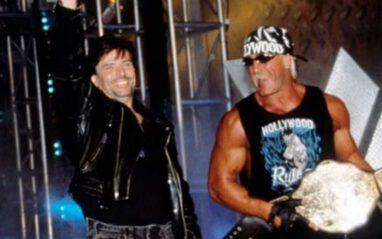
Eric Bischoff insists his decision to join the nWo had nothing to do with feeding his ego. The former WCW President revealed that he actually wanted to step away from television before a growing creative problem forced the company to reconsider his on-screen role.
Speaking on 83 Weeks, Bischoff looked back at the November 18, 1996, episode of WCW Monday Nitro, when Roddy Piper confronted him over unsuccessful negotiations for a match against Hulk Hogan. The segment ended up exposing Bischoff as a member of the nWo when Hogan embraced him in the ring, revealing that the man representing WCW was secretly working with the faction. Bischoff explained that although the reveal appeared to have been carefully planned from the beginning, his involvement with the nWo wasn’t something WCW had mapped out months in advance.
“In a way, I was part of the story previous to this night as the announcer and representative of WCW, the play-by-play guy, and obviously executive producer and all that that everybody knew about. So I was already a part of the story. It was nWo versus WCW. People just didn’t realize which side I was on.
It’s not like the design for me coming out as a character and being a part of the nWo was something that we had planned well in advance. It was more out of necessity, really, than anything else.”
Bischoff admitted that he wasn’t interested in expanding his television presence at the time. In fact, he would have preferred to disappear from WCW programming altogether and focus on his responsibilities behind the scenes.
“I wasn’t initially interested in getting any more involved in play-by-play or on camera at that point in time. If I would have not been convinced that this was a good idea, I would have much preferred to fade away from on-camera work and just concentrate strictly on running the company and the show.”
The problem WCW faced was explaining how the nWo could continually wreak havoc without facing serious consequences from company officials. Bischoff said the storyline was becoming increasingly difficult to justify without revealing that someone in power was protecting the group.
“It became apparent in the months preceding this where it was getting harder and harder to explain some of the things that the nWo was willing or able to get away with. We kept bumping up against the, ‘Yeah, but if this was real, Turner security or, you know, there would be action. These guys wouldn’t be able to get away with all this stuff.’
There has to be some boundaries somewhere. You have to create them before you can break them. It’s kind of like rules, right? You need rules to some degree to kind of create the architecture for your storytelling so that, if need be, you can break the rules and then raise the stakes or the consequences, things like that.”
Bischoff couldn’t remember who originally suggested making him a member of the nWo, but he immediately recognized the creative benefits. He also knew people would assume he was simply looking for an excuse to put himself on television.
“We were bumping up against that kind of creative challenge more and more and more often, to the point where somebody, it might have been me, it might have been somebody else, came up with the idea of, ‘Hey, what if it’s Eric?’ And early on, I knew it was a good idea.
Everybody’s going to think, ‘Oh, you just want to put yourself on TV.’ And it really wasn’t that. I’ve never really cared about that other than the fact that it’s how I made my money, but it didn’t mean anything to me for my ego or any of that kind of stuff. Never has, still doesn’t. Actually, even less so today.”
Bischoff estimated that the decision came together roughly one or two months before his heel turn. Once the idea was established, he had no concerns about being able to perform the character.
“It really explained a lot of shit, right? Even though we hadn’t planned it and created that architecture early on, at some point probably a month or two preceding this moment, it was like, ‘Okay, we need to figure this out.’ Whoever came up with the idea, it was kind of like, ‘Okay, this will work.’
In terms of the performance or the opportunity to perform or play that character, it was so easy. It was so easy. I mean, it was a built-in story. I had been on camera for a number of years at that point, probably eight or 10 years on camera. So it wasn’t like I didn’t think I could pull it off.”
Bischoff also praised Roddy Piper, Hulk Hogan, Scott Hall and Kevin Nash for their performances during the segment, admitting that looking back on the footage made him appreciate the opportunity to work alongside them. The former WCW President has previously discussed the importance of the nWo’s storytelling, even blaming bad creative for modern wrestling’s inability to produce another faction like it.
Bischoff became one of the most recognizable authority figures in professional wrestling after joining the nWo, but according to him, that wasn’t the goal. WCW needed an explanation for why Hogan and his crew could get away with practically anything, and putting the boss on their side solved that problem.
How do you think the nWo storyline would have played out if Eric Bischoff had remained loyal to WCW instead of turning heel? Please share your thoughts and feedback in the comments.
This transcript was produced exclusively for Ringside News from the original recording. Republishing the transcription in full is prohibited. When using excerpts, provide prominent credit and a link to this article.
