
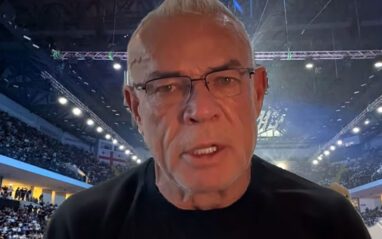
Eric Bischoff has no desire to be back in the hot seat booking professional wrestling. The former WCW President admitted he’s glad to be watching from the sidelines because modern television demands and shrinking audience attention spans have made wrestling storytelling much more difficult.
During an episode of 83 Weeks, Conrad Thompson brought up the patience WCW demonstrated when developing Sting’s storyline with the nWo in 1996. Thompson pointed out how different the pacing was compared to modern professional wrestling, prompting Bischoff to explain why he’s thankful he isn’t dealing with those creative challenges today.
“Don’t get me wrong, I’m so grateful for the opportunities that this industry has provided and the chance I got to be involved in creative in a variety of different levels. But I’m so glad I’m not doing it today because the audience is so much different and the constraints of television are so much different today.”
Bischoff made it clear that adapting to changing audience habits isn’t necessarily his biggest concern. Instead, he pointed to television formats and the number of commercial breaks wrestling companies are required to accommodate because of their dependence on broadcast rights revenue.
“That probably would be my biggest issue. Look, I can adapt and am adapting and understand adaptation, as we talked about earlier, in terms of staying ahead of the audience. Don’t try to keep up with the audience. Stay ahead of the audience as best you can. So I do spend a lot of time thinking about that.
That’s not the biggest hurdle sometimes. I think the biggest hurdle is just look at the structure of a television format. Look at the amount of commercial breaks. Most companies are still living off their broadcast rights for the most part, or at least a significant portion of the revenue. So you’re a slave to your business partner, in this case broadcast or cable, which means you’re going to have to build in commercial time for your show.”
Bischoff also explained that wrestling producers have fewer storytelling tools at their disposal than those working on traditional television dramas. While wrestlers are talented physical performers, he argued that they aren’t necessarily trained actors capable of carrying a show through dialogue alone.
“Every storyteller has the same issue. But with wrestling, you don’t have the tools in your toolbox as a producer to hold on to your audience. It’s basically two things. It’s physical action and narrative. And these aren’t great actors. They’re not great directors. They’re amazing performers, and some of them can act, but generally speaking, these are men and women that could go out and tell a story with their bodies to entertain the audience.
So you don’t have a lot of different tools to use to hold them. A two-hour show with the commercial breaks that we’re talking about, trying to hold an audience so that the audience continues to build ideally, and at least it used to, that’s really hard to do the way formats are structured now and the amount of commercial time in there.”
Another major concern for Bischoff is how quickly audiences lose interest. He believes people have become accustomed to constant stimulation, leaving wrestling companies with less time to develop characters and meaningful storylines.
“It’s one of the challenges. The other one is, of course, the audience’s attention span. We’re being conditioned. Our brains are being rewired. Our neural pathways are evolving and adapting to look for these constant little hits of dopamine every 15 minutes or less.
Everything is shorter attention span. Everything is shorter attention span, which means you can’t spend as much time trying to get a character or a story over. You don’t have as much time, I should say, to get a character or story over because the audience is kind of looking around. It’s like bright, shiny objects everywhere.
So all of those things make it a lot more challenging today, and I’m glad I’m on the sidelines watching.”
This isn’t the first time Bischoff has raised concerns about modern wrestling television formats. He previously criticized WWE’s decision to expand SmackDown to three hours, arguing that the additional television time creates problems from a creative standpoint.
Bischoff spent years going head-to-head with Vince McMahon during one of the most competitive periods in wrestling history, but he’s perfectly happy sitting this one out. Between commercial breaks, demanding television schedules and audiences constantly looking for the next big thing, the former WCW boss isn’t exactly itching to get his old job back.
What do you think is the biggest obstacle preventing wrestling companies from telling better long-term stories today? Please share your thoughts and feedback in the comments.
This transcript was produced exclusively for Ringside News from the original recording. Republishing the transcription in full is prohibited. When using excerpts, provide prominent credit and a link to this article.
