
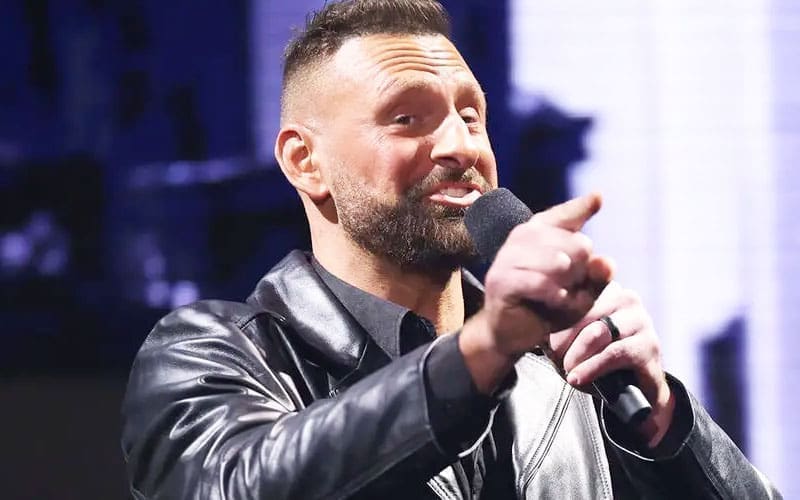
Dijak has had enough of wrestling fans turning real injuries into punchlines. Following AEW All Out 2026, the former WWE star delivered a lengthy message about the treatment of injured performers—and made it clear he was addressing a problem much bigger than one incident.
Taking to Twitter/X after the pay-per-view, Dijak criticized what he described as a growing lack of empathy across parts of the wrestling audience. He later clarified that his comments weren’t aimed at one specific wrestler or moment, saying he had seen three separate viral examples of injury or distress that night alone.
“There is a growing trend lately among some segments of the pro wrestling fanbase where people are showing an abhorrent and complete lack of empathy for professional wrestlers getting legitimately injured.”
Dijak acknowledged that wrestling itself can complicate how fans react. The business routinely asks audiences to celebrate a villain getting hurt, and sometimes uses fake injuries to manipulate those same emotions.
“I understand this is a grey area because, on the one hand, we are literally always presenting you with the story of, ‘Hey, watch this jerk get hurt because it’s what they deserve.’ I also understand that this is often further compounded by the fact that we also often present the story of, ‘They are actually hurt… just kidding, they are a faking jerk.’”
But Dijak argued that uncertainty should give people a reason to pause before piling on. Behind the character is someone potentially finding out, in front of an audience, that their health and livelihood have changed.
“That being said, try to err on the side of caution when appropriate. That’s a real human being with real emotions trying to process the extent of their injury in real time and how it will impact the people in their lives who rely on them physically and/or financially.”
He also took aim at the way injury footage becomes material for jokes online. A clip might last seconds, but the person in it could be dealing with the consequences long after everyone else has moved on.
“Or, for another common example, there is a real person in that viral clip that you jokingly commented on, and they might now have to deal with the potential lifelong ramifications of a serious head/neck/body injury.”
Dijak didn’t dodge the argument that wrestlers knowingly accept physical risks. He addressed it directly, including the assumption that everyone taking those risks is making serious money.
“Do we sign up for this? Yes. Do we understand the risks? Yes. Are some of us financially compensated handsomely for this risk? Some, yes, but not most.”
For Dijak, accepting the dangers of the job doesn’t mean performers should expect ridicule when something goes wrong. He reminded fans why wrestlers get into the ring in the first place.
“None of this changes the fact that anyone who has ever stepped foot in a pro wrestling ring did that with the intent of entertaining you, the people, the fans, and if something legitimately negative happens to us on our journey toward achieving that goal, we don’t want to be mocked or ridiculed for trying our best to bring you joy.”
His criticism also extended beyond injuries to the reactions when wrestlers lose their jobs. At the same time, he acknowledged that performers can deserve criticism for their own behavior.
“This includes another common circumstance in the pro wrestling world, and that’s wrestlers getting fired/released/un-renewed.”
“Do some wrestlers say or do controversial/polarizing things? Yep. Are some just genuinely bad people who do genuinely bad things? Unfortunately, yes.”
Dijak urged people to address specific wrongdoing instead of treating someone’s injury or unemployment as payback. His point was that accountability requires more than deciding a person deserved something bad happening to them.
“Try your best as an observer to critically identify when this is factually and definitively the case, and then directly address that action or statement as opposed to abstractly determining that the wrestler ‘got what they deserved,’ which doesn’t facilitate any meaningful change or influence, it just adds on more negativity.”
He ended the original message with a much shorter version of that argument. Fans could still enjoy wrestling, criticize it and speak their minds without celebrating somebody’s suffering.
“Long story short, enjoy, have fun, have an opinion, voice your opinion, but don’t be a dick.”
When people began speculating about what prompted the post, Dijak shut down the idea that he was responding to one particular incident. He said the reactions he witnessed that night included disrespect both online and inside a venue.
“For those of you speculating that this is my responding commentary on one specific instance, that would be incorrect. Like I said, this is a growing trend. Last night alone I saw three separate viral instances of wrestlers suffering varying degrees of injury/distress, and all three had a public discourse laced with judgement and disrespect. In some instances the negativity was audibly taking place at the venue in real time.”
Dijak added that this wasn’t something he had only just noticed. From his perspective, the behavior had become increasingly common over the previous six months.
“As someone who follows the entire pro wrestling landscape closely and from a unique perspective, I can tell you all that this unfortunate trend has grown rapidly over the past 6 months to the point where I see multiple incidents on a weekly basis.”
Dijak’s message leaves plenty of room to boo a villain or tear apart a match. What he’s taking issue with is the moment a real person gets hurt or loses their job—and part of the audience decides that’s the entertainment.
Where do you think wrestling fans cross the line between criticizing performers and celebrating their misfortune? Leave your thoughts in the comments.
